Live on Google Play · iOS beta on TestFlight
Encrypt your money
and your messages.
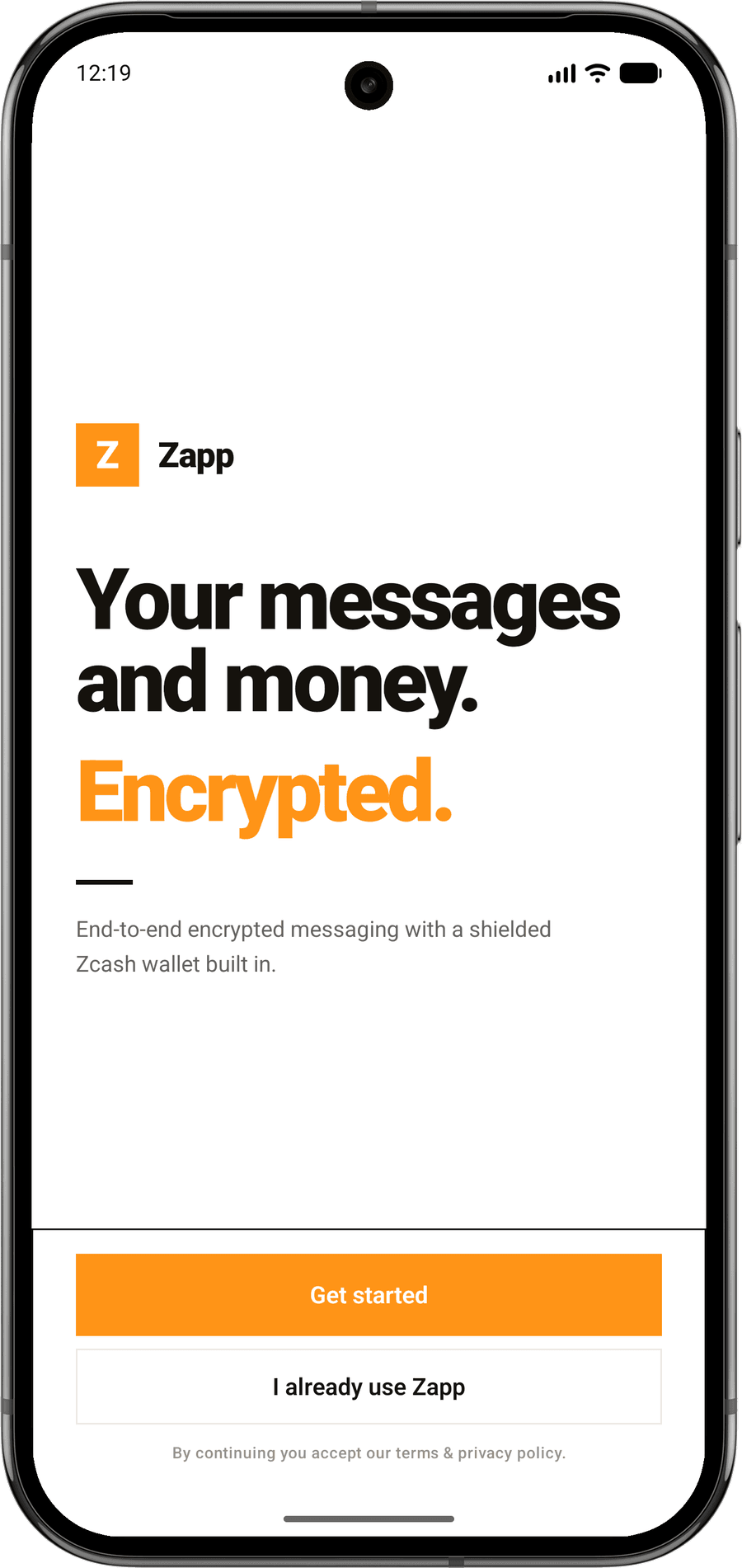
Zapp is a shielded Zcash wallet with peer-to-peer encrypted messaging built in. No middlemen, no centralized servers, and no compromise on your privacy.
Buy ZEC in your own currency, pay merchants with it, cash out to the bank app you already use. No phone number, no email, no ID.
Messaging
Holepunch P2P
The stack behind Keet
Wallet
Zodl fork
By Zcash's creators
Swaps
NEAR Intents
No exchange account
Fiat rails
P2P.me + Peer
Buy, spend, cash out
Private money should bespendable money.That's why we built Zapp to settle in fiat.
On a transparent blockchain, every payment you ever make is public: the amount, the counterparty, the time, forever. Anyone who learns your address can read your balance and your entire history.
Zcash closed that gap with shielded transactions: encryption at the protocol level, not obfuscation. Zapp brings that same protection to your messages, so your money and your chats live in one app, secured by a single seed phrase.
Spendable here
The rails your shielded balance already reaches.
- UPI
- Revolut
- PIX
- Zelle
- QRIS
- Chime
- Mercado Pago
- Monzo
- Pago Móvil, Banco de Venezuela




What's inside
Private money. Private messages. Real-world rails.
A messenger and a wallet in one app, with no compromise on your privacy.
01
Messaging without middlemen
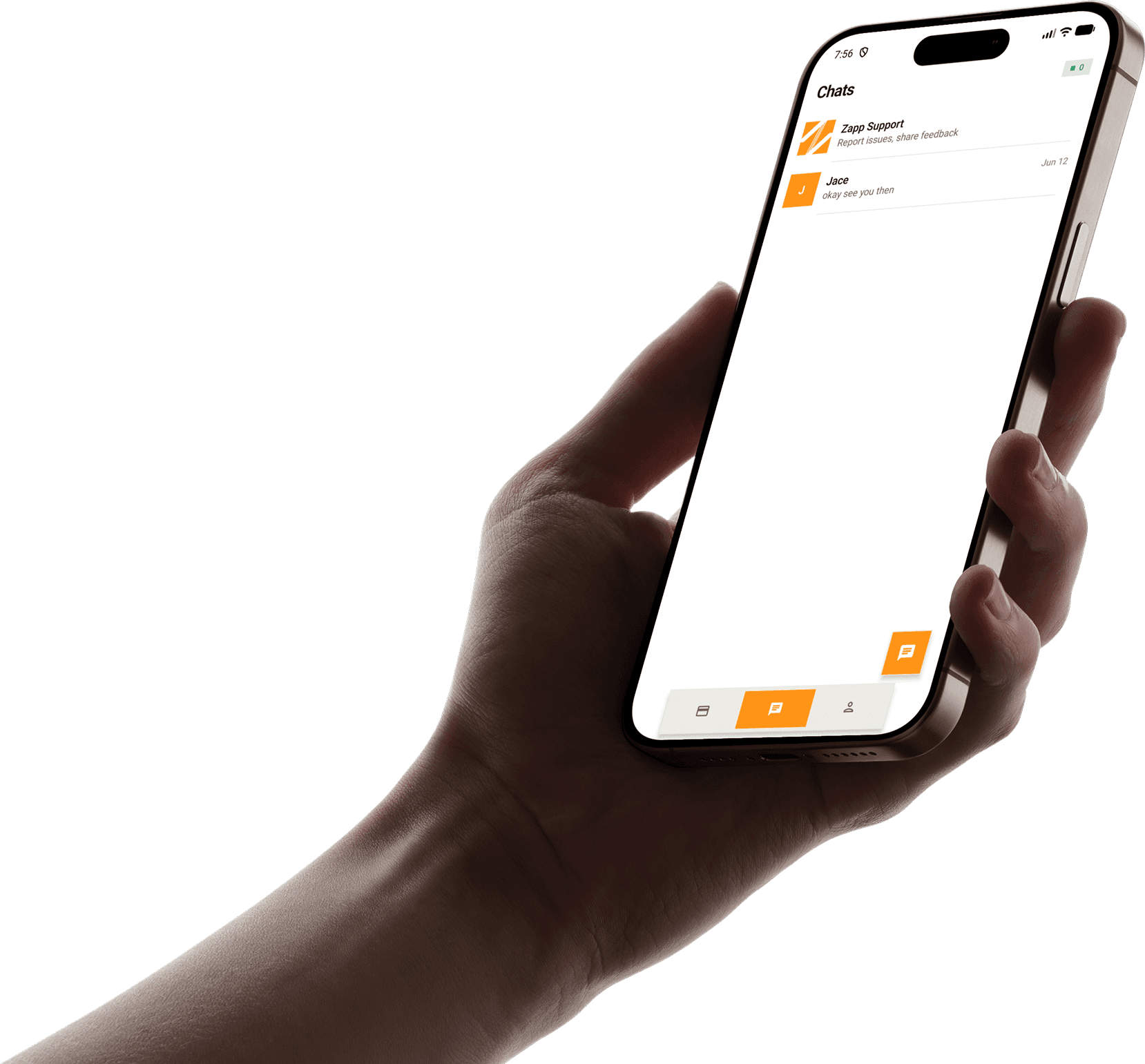
Every message is end-to-end encrypted and travels directly between devices over Holepunch, the peer-to-peer stack behind Keet. There is no messaging server to breach, subpoena, or shut down.
02
Money that moves like a message
The shielded Zcash wallet lives inside every conversation. Tap the payment icon, enter an amount, send. Paying a friend feels like sending a text.
03
Swaps without an exchange
Move between ZEC and USDC inside the app through NEAR Intents. No exchange account, no order book, and no custodian holding your funds while the trade settles.
 NEAR Intents
Merchant payments
Pay at the counter.
Keep your privacy.
Point the app at the code on the counter, and the shop is paid in the currency it already accepts, straight out of your shielded balance.
The conversion runs through a wallet created for that one order, so nothing ties the payout back to your balance, your history, or the last place you spent.
What the counter sees
- An ordinary payment on the rail they already use
- The exact amount, in the money they already take
- Settled in minutes, into the account they always use
- Nothing to install, and no crypto to learn
What nobody sees
- Your balance
- Your payment history
- Your name, your number, your documents
- Any link between this payment and the last one
The rails
Money in. Money out.
A private wallet is only useful if value can get in and out of it. Two peer-to-peer protocols do the settling, and neither one requires an exchange account or an identity check.

Local rails, both directions
Buy ZEC by paying a matched merchant in your own currency, pay a shop's code straight from your shielded balance, or send it to your own payment ID. Verified peers settle it against on-chain escrow.
Live on UPI, PIX, QRIS, Mercado Pago and Pago Móvil. Nigeria and Colombia are wired up next.
Cash out to your bank app
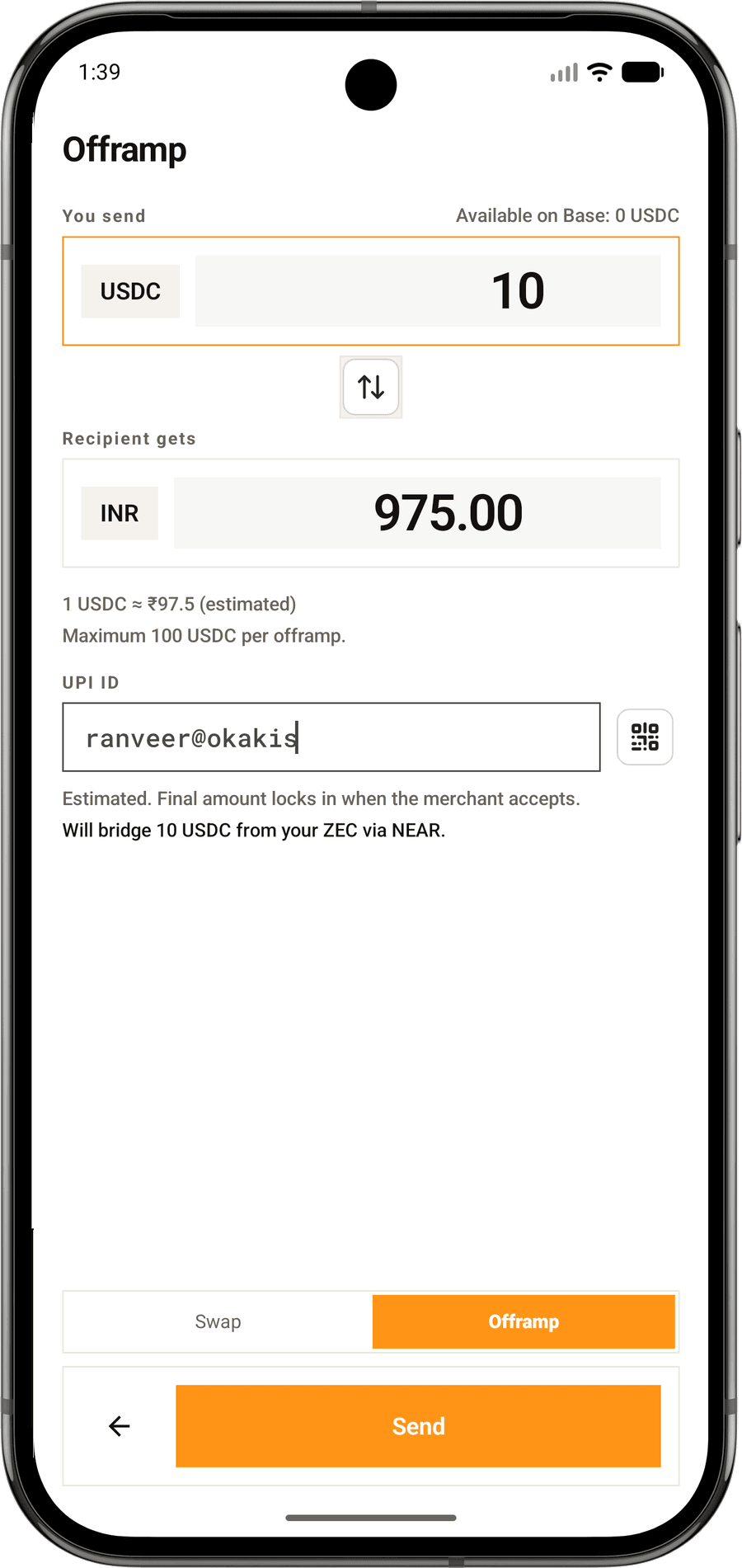
Post an order for what you want, and a buyer pays you directly on Revolut, Zelle, Chime or Monzo. The protocol checks their payment proof and releases your USDC on its own.
Live in US dollars, euros and pounds sterling, from 20 USDC.
No KYC on either rail. Zapp never holds your funds, and never sees the payment details you hand to the person on the other side.
The foundation
Security inherited, not invented
Zapp's wallet is built on Zodl, the flagship open-source Zcash wallet from the team that created the protocol itself. Every release inherits Zodl's architecture, its shielded-by-default design, and years of security hardening, and we track upstream to port improvements as they ship.
Everything we add on top, messaging, swaps, and the rails that move money in and out, is built the same way: non-custodial and peer-to-peer, with no servers in the middle.
01
Self-custody, always
Your keys are generated on your device and never leave it. We cannot move, freeze, or even see your funds. One recovery phrase restores your wallet and your chat identity.
02
Shielded by default
Payments use shielded Zcash, so amounts, balances, and counterparties stay off the public ledger. Transparent ZEC that arrives can be shielded in one tap.
03
Nothing to know about you
No accounts, no analytics, no tracking SDKs. Zapp collects nothing about you, so there is nothing to leak, sell, or hand over.
Open source
All of our code is
open source.
The Android app, the iOS app and the peer-to-peer messaging SDK are all public under AGPL-3.0.
Browse the sourceQuestions
Frequently asked questions
What is Zapp?
Zapp is a shielded Zcash wallet with peer-to-peer encrypted messaging built in. Payments are shielded Zcash: encrypted on-chain and invisible on the public ledger. Messages travel directly between devices over Holepunch, with no servers in the middle. The wallet is a direct fork of Zodl, the flagship Zcash wallet.
How is Zapp different from WhatsApp, Telegram, or Signal?
All three need an account and route your traffic through their servers. Even when the content is encrypted, the record of who talks to whom is theirs to keep. Zapp has no servers and no accounts, so that record is never collected anywhere. And none of them carry private money: Zapp's payments are shielded Zcash, settled between you and the recipient.
Do I need a phone number or an email address?
No. There is no sign-up at all. Your chat identity and your wallet both derive from one seed phrase generated on your device. Nobody, including us, learns who you are.
Who can read my messages?
Only the people in the conversation. Messages are end-to-end encrypted and exchanged directly between devices. There is no Zapp server that could read, store, or hand over your conversations, because there is no Zapp server at all.
Who holds my money?
You do. Zapp is non-custodial: your keys are generated and stored only on your device. We cannot move, freeze, or even see your funds. One recovery phrase restores both your wallet and your chat identity.
Where do I get ZEC in the first place?
Inside the app. Buy ZEC matches you with a merchant, you pay them in your local currency on the payment app you already use, and shielded ZEC arrives in your wallet. The purchase settles as USDC in your own account on Base and converts straight through to ZEC, so no custodian ever holds it for you. If you close the app or reinstall, the order picks up where it left off on the same recovery phrase.
How do I turn ZEC into cash?
Two ways, both peer-to-peer. Send it to your own UPI, PIX, QRIS, Mercado Pago or Pago Móvil account and a verified peer on the P2P.me protocol settles the local currency, secured by on-chain escrow. Or post an order on Peer (ZKP2P) and a buyer pays you directly on Revolut, Zelle, Chime, or Monzo, with the protocol releasing your USDC against their payment proof. No exchange account and no identity checks either way, and every order runs through a fresh wallet so nothing links the payout back to your balance or history.
Can I pay at a shop with it?
Yes. Point Zapp at the payment code on the counter and the merchant is paid in the currency they already accept, out of your shielded balance. They see an ordinary payment; they do not see your balance, your history, or your identity, and there is nothing for them to install.
What happens if I lose my phone?
Your money survives; your messages do not. The recovery phrase restores your wallet and your chat identity on a new device. Chat history lives only on the device it happened on, which is exactly what makes it private.
Is Zapp open source?
Completely. The Android app, the iOS app, the peer-to-peer messaging SDK, and this website are all public on GitHub under AGPL-3.0, a licence that requires anyone shipping a modified version to publish their changes too. Every privacy claim on this page is something you can go and verify in the code rather than take our word for.
Is Zapp free?
Yes. The app is free, with no ads and no subscriptions. You pay normal Zcash network fees when you transact, and the third-party protocols behind swaps, the onramp, and the offramp set their own rates.
More questions, including swaps and recovery details, in the full FAQ.
Live on Google Play · iOS beta on TestFlight
Your money and your messages
Encrypted.
No server to breach. No account to mine. No custodian to trust. Zapp is free on Google Play and in public beta on TestFlight.
Questions first? Read the FAQ